
How To Ghostwrite A Perfect Newsletter
Master this skill to sell high-ticket email ghostwriting services to premium clients



Enrollment for Newsletter Ghostwriting Bootcamp is LIVE! Over 14 days, starting May 18th, we’ll show you how to land your first (or next) high-paying email client. Click here to learn more (and secure your spot).
There is one truth about writing I want every ghostwriter to internalize and never forget:
Writing is like playing with Legos.
In other words, you want to see writing as modular. Don’t see it as a big, daunting “thing” artists and the inspired do. It’s actually all about assembling pieces to create a finished piece of writing.
So, in this Deep Dive, I’m going to explain 3 writing frameworks that can be used to write any piece of content—and show you can write a perfect newsletter with them.
Let’s dive in!
How To Write The Perfect Newsletter
In order to write the perfect newsletter, there are really only three frameworks that you need to know to get to 80, 90, 95% proficiency.
Everything else is little stylistic things that maybe you pick up or choose to do later on (which we’ll talk about right at the end of this newsletter).
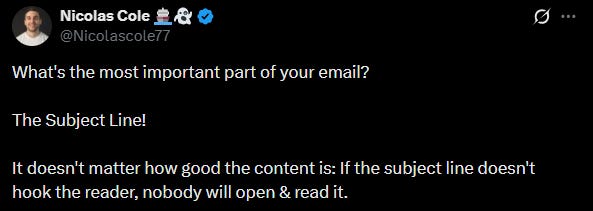
But before we get to these frameworks and the actual WRITING, we need to decide on a subject line.
Framework 0: Writing A Subject Line
To write a compelling and clickable subject line that will drive high open rates, follow these 5 rules:
Rule #1: 5-15 words, max. A good rule of thumb is that your subject line should not exceed 15 words. Ever. Less is always more here.
Rule #2: Subject lines should read like you’re talking to a friend. This comes down to grammar & punctuation more than anything else. Use sentence-case over a capitalized subject line.
Rule #3: Use 1 of the 4 proven hooks. There are 4 types of hooks that work over and over again (regardless of industry, niche, or topic): Here’s a ton of value for minimal time, here’s a ton of value for minimal cost, here’s how to solve your problem without much effort, and here’s how to unlock this desirable outcome, instantly.
Rule #4: Use visceral language! “Amp up” your subject lines even more by adding in visceral language like: “OUCH!” “Urgent!” “Steal this!”
Rule #5: Name & Claim ideas (in the subject line) The ultimate goal is to Name & Claim ideas right there in the subject line. E.g. “Life Coach Money Manual: 3 easy ways to 10x your monthly earnings (nobody tells you this)” You should be able to feel (in your skin!) how much more you want to click this subject line—because “Life Coach Money Manual” feels like you’re receiving a “thing.” This makes it feel exponentially more “valuable.”
The challenge, of course, is doing all of this WITHOUT exceeding the word count limit for effective subject lines.
Alright, now onto the 3 core frameworks.
Framework 1: Think In Lists
Everything in writing is a list:
Non-fiction is a list of facts, advice, stories, etc.
Fiction is a list of descriptions & dialogue that move the plot forward
Even poetry is a list of images and ideas
If you can’t think in lists, you won’t be able to write 800 words, let alone 8,000 for an article or 80,000 for a book.
Yet most writers skip this crucial step and dive straight into writing. This is a huge problem! It’s like walking through a forest at midnight with just a flashlight. Without a list of what they’re going to cover, they have no clue where they’re going.
So, how do we apply this to writing a newsletter?
Well, before you write a single word, you need to realize that 80% of your newsletter’s value is in the headers. When readers open your email, they don’t read—they skim. They scan your headers to decide if the rest is worth their time.
If you’re sharing tips, each header should be an actionable tip.
If you’re sharing lessons, each header should be a valuable lesson.
If you’re writing about mistakes, each header should be a specific mistake.
Because once your reader has opened the email (based on the subject line), the headers serve an important function:
The headers ARE the promise of the newsletter.
When you pick a topic like “inbox zero,” that’s not what your newsletter is about.
Your newsletter is about the specific thing you’re giving readers in service of that topic:
3 TOOLS to achieve inbox zero
3 MISTAKES that prevent inbox zero
3 REASONS you’re failing at inbox zero
3 daily HABITS for maintaining inbox zero
Just by changing one word—mistakes to tools to habits to reasons—you create a completely different newsletter.
The topic stays the same, but what you’re giving the reader transforms entirely. So, before writing anything, create your containers. List your headers. Bold them.
Congratulations—you’ve just completed 50% of the work, and the thinking is done.
The house is built. Now you just need to add furniture.
Framework 2: Use Single Sentence Openers
Once your headers are set, you need to write some single sentence openers to HOOK your reader.
There are 6 ways to hook a reader at the start of any section.
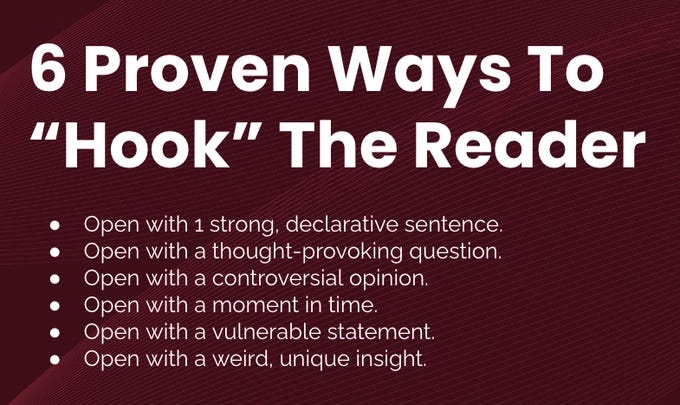
When I sit down to write, I’m not hoping something brilliant appears—I’m choosing from these options:
Strong declarative sentence: “Most writers fail before they even start typing.”
Thought-provoking question: “What if everything you learned about writing was wrong?”
Controversial opinion: “Not using outline templates is killing your creativity.”
Moment in time: “At 4:47 AM, I discovered the secret to viral newsletters.”
Vulnerable statement: “I wasted 3 years writing newsletters nobody read.”
Weird unique insight: “The best newsletters are written backwards.”
For each section, I quickly run through these 6 options and pick the strongest one.
After doing this 10,000 times as a ghostwriter, it happens in seconds. But don’t feel “bad” if your first few attempts feel mechanical—that’s the point! You’re using a reliable system, not relying on inspiration.
Without compelling single-sentence openers, even brilliant content goes unread. If your first line is generic, readers assume the entire section is generic. They’ll bounce before reading the meat of your newsletter.
Master this framework and readers will actually finish your newsletters instead of skimming and leaving.
Framework 3: Use The 10 Magical Ways To Expand Any Section
So, how do you keep the reader hooked now you’ve got their attention?
Easy—you add the meat of the newsletter, expanding each section with valuable content.
When you fill out a section, you’re delivering on the promise of the header. And you can do this by expanding the idea by giving readers more of what they want.
You can do this with the 10 Magical Ways to expand anything:
Tips: Actionable advice they can implement immediately
Stats: Numbers that prove your point or surprise them
Steps: Sequential instructions to achieve a result
Lessons: Wisdom extracted from experience
Benefits: Positive outcomes they’ll gain
Reasons: Logic that supports your argument
Mistakes: Common errors to avoid
Examples: Real-world applications of your ideas
Questions: They can ask these to help them understand a point/achieve an outcome
Personal stories: To illustrate the point of the header
Once you view writing through this modular lens, you’re never stuck.
You simply ask: “What does this section need?” Then pick from your toolbox. This turns writing from a mysterious, almost mystical act to… building with Legos!
And once you internalize these 3 frameworks, you’ll write faster, clearer, and more engagingly than 95% of writers out there.
Add In The Last 5%
Alright, 95% of the newsletter is done!
The last 5% is achieved by adding in the small, stylistic things:
What’s your PS? This could be adding more value, offering a “next step” to help them (e.g. a product or service), or a TL;DR summary of the email (which creates an open loop for those skimmers to actually read the content!).
What’s your CTA? This could be to a product/service to another resource that’ll help them implement whatever you covered in the newsletter.
What media (e.g. pictures) are you including? Pictures are a great way to break up the content in your email and add more context.
How are you formatting each section? This is MASSIVELY important. Using bulleted lists and writing rhythms is how you make your newsletter visually appealing, keep it organized, and make it easy to read and skim. If you DON’T do this, and you make it HARD for readers to consume your content, then it won’t matter how “good” the content is.
Use these 3 frameworks to turn your newsletters from ignored emails into must-read content.
Want more help ghostwriting newsletters you can sell?
Then join our 2-week Newsletter Ghostwriting Bootcamp.
In just 14 days, we’ll show you how to:
Niche down (and eliminate all competition)
Write newsletters you can sell to high-ticket clients
Perform outreach & sales that'll actually get you clients
And tons more!
Click here to secure your spot here (and claim some extra special bonuses!).
That’s it!
—Nicolas Cole & Dickie Bush
Co-Founders of Ship 30 For 30
Co-Founders of Premium Ghostwriting Academy
Co-Founders of Typeshare
Co-Founders of Ghostbase
Co-Founders of Write With AI